

Easy to grasp
Faster, higher, further: striving for improvement is part of human nature. This is why the economy is constantly evolving - logically. Production in particular - logistically. The once clearly separate areas of production and logistics are becoming increasingly intertwined and have merged to form a new discipline: intralogistics.
We are used to simply buying many of the things we need every day online: select them, order them and have them ready to use the next day. Same-day delivery, omnichannel, individualization... This is how online shopping works today. Meanwhile, have you ever thought about what this means for companies along the value chain? What we now take for granted is the result of a sophisticated interplay of various processes for the storage, preparation, packaging and transportation of products. Internal material and goods flows - summarized under the term „intralogistics“ - are becoming an increasingly important success factor. For companies, this means facing up to challenges such as batch size 1, uncertain process conditions and shorter throughput times. After all, customer satisfaction and ultimately the success of the company depend to a large extent on smooth, fast processes.
In addition to consumer demand for individuality, speed and flexibility, the wide variety of product ranges and articles that make up today's e-commerce plays a central role in internal process design. For order picking, which means putting together a partial quantity (item) from a provided total quantity (assortment), this means moving away from case picking towards piece picking. Instead of cartons with products, the products themselves are separated from the cartons. If make-up is still on the packing list one moment, it is suddenly pharmaceuticals the next.
Figures show that piece picking is a key growth driver.
The products, in turn, can have a wide variety of geometries in a matter of seconds: Tubes, cylinders, cuboids and blister packs are the most common shapes. These are used for toothpaste, toothbrushes, lipstick and tablets, for example. Particularly in the up-and-coming healthcare, cosmetics, pharmaceutical and clothing segments, it is therefore more important than ever for companies to rely on a flexible and, above all, reliable overall logistics system, both in terms of software and hardware.
Shorter response times
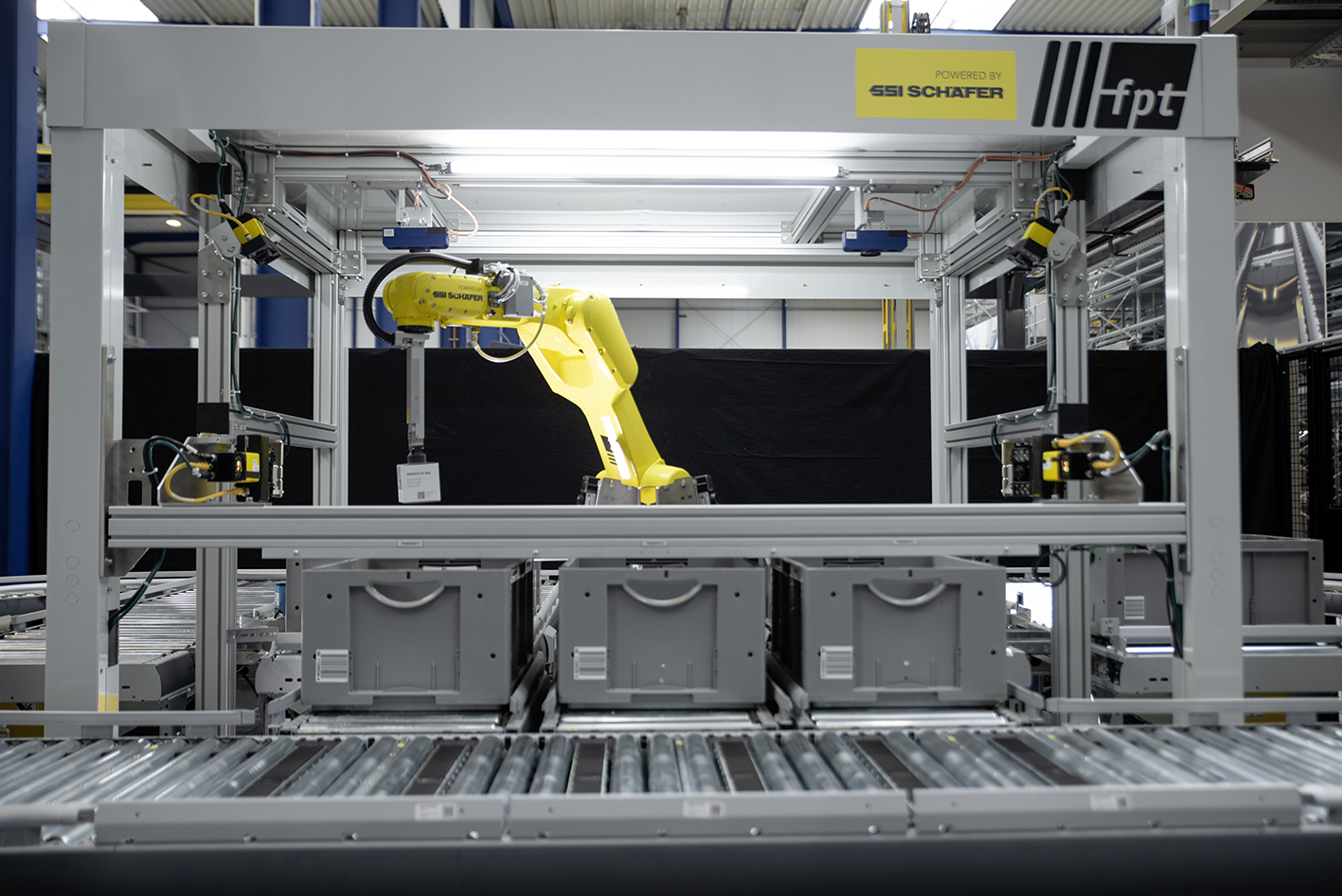
As varied and diverse as the range of items may be, the system used for order picking should be able to handle every single part, no matter how small - ideally fully automated, of course. This initially requires three components: a camera system for visual recognition, a robot system for error-free handling and a material flow system for internal transportation. In addition, these three components must be able to communicate with each other via so-called interfaces. This could be compared to a golfer and his caddie: the caddie (material flow and camera) helps with club selection and reading the green, the golfer himself (robot) then executes the shot.
From the world of sport but back to technology: the material flow system first ensures that the items are made available for picking. The starting point is the high-bay warehouse. If a customer's shopping basket consists of throat tablets, nasal spray and a vitamin preparation, for example, the shuttle system picks up the corresponding article containers or cartons and delivers them one after the other to the transfer point. Here, driverless transport systems or conveyor belts take over the onward transportation of the individual containers. From the warehouse, the route leads to the picking station: the link between the warehouse and dispatch. The camera system first analyzes the shape and position of the items and reports this to the robot at the same moment. The separation process begins. Based on the order data, a six-axis robot now separates the items into the corresponding order containers or shipping cartons: first tablets, then sprays and finally the preparation. From the item's perspective, the robot gripper slowly approaches and lifts it vertically upwards. Now the robot accelerates its arm together with the item up to the shipping carton. The system uses the maximum permissible acceleration values for the respective product class to ensure lean yet safe handling. Medical products, for example, must be moved with particular care during this process. Finally, the gripper places the item back into the designated order container at a reduced speed. The ready-to-ship carton is then ready without a person having to pick up the items themselves. The big plus: thanks to the flexible article supply at several infeed stations, up to three picking orders from eight different sources can be processed simultaneously. This enables cycle times of up to 1,000 picks per hour to be achieved. Simply gripping, isn't it?
Cycle times of up to 1,000 picks per hour can be achieved.
The combination of precise robot and gripper technology, visual object recognition and customized software makes the teaching of individual items superfluous. So the product range can be expanded as required? That's a good guess! In this way, companies can react more quickly to changing market requirements and add new items to their range without any actual additional expense. The robot, camera and conveyor technology form a compact robotic system with standardized interfaces, allowing easy integration into existing material flow and IT systems.
Sounds difficult? It is!
The challenges lie in process stability and safety on the one hand and process transparency on the other. Suppose the customer mistakenly receives magnesium instead of the vitamin supplement. Obviously plagued by a persistent cold, a dietary supplement for use during sport is of little use to him at this moment. This is why the mobile cell unit is supplemented by quality assurance systems that ensure error-free handling. An integrated barcode scanner ensures that the item specified in the order data is selected correctly. An additional light grid controls the delivery of the article into the order container. The documentation of the separation process, which runs in parallel via camera, ultimately helps companies to make their supply chain management more transparent. What happens in the background of the system is complex - of course. The use of robotics in order picking was only made possible by our constant striving for improvement - also clear. The most important insight here is that if automating logistics tasks were easy, anyone could do it. But it is not. That's why people will continue to strive for improvement in the future. That's obvious, isn't it?
The so-called „piece picking application“ is an intelligent interplay of robotics and material flow. The solution was developed by automation specialist fpt robotics in collaboration with SSI Schaefer, the world's leading solution provider of modular storage and logistics systems. The cooperation between the two companies works just as well as the individual system components complement each other. Together, they can draw on many years of experience in the fields of robotics and intralogistics. The result is impressive: The piece picking solution covers the requirements of a wide variety of order structures and can be used across all industries. The automatic and, if desired, semi-automatic process design of picking tasks increases efficiency and also reduces the ergonomic burden on people.